Discovery & Framing
The Discovery & Framing is the initial phase of an agile project and is used to rough it out.
Agile Method: General Overview
“Discovery and Framing” are two associated terms (discovery and framing) that describe an initial phase preceding the sprints.
Note: This post was translated from french with the help of AI. The original post was written with the knowledge of a younger me.
This phase is used to rough out a project and formalize it so it can be conducted using the agile method. It generally spans one week.
It is structured in two parts: discovery and framing (hence the name).
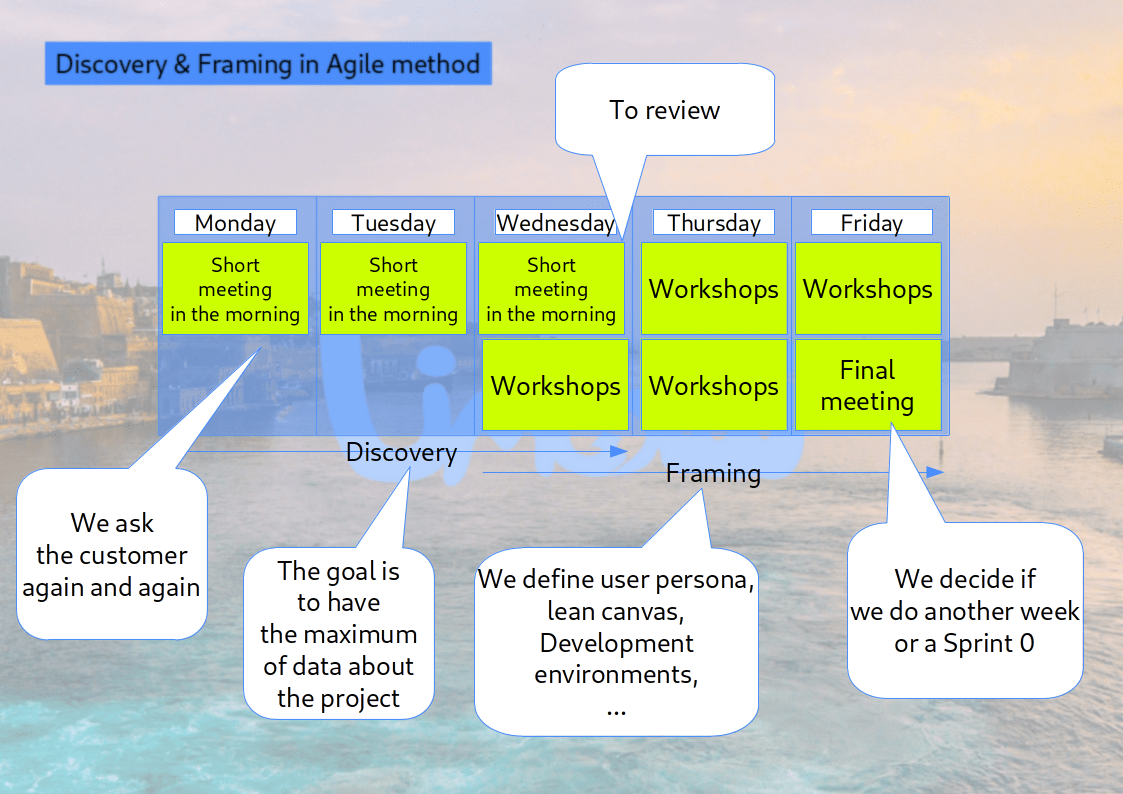
Discovery & Framing in Agile Method
It is structured in two parts: discovery and framing (hence the name)Discovery
It starts on Monday and ideally ends on Wednesday.
Each day, hypotheses about the project are detailed and clients are interviewed extensively. A meeting is held every morning to gather results and start again (similar to scrum).
Do not try to estimate time; this is a research phase. If this phase extends too far beyond Wednesday, it may be necessary to schedule another week.
Framing (Formalization)
From Wednesday onwards, you can start creating workshops within the teams. These workshops aim to define the main identifiers of the project:
-
The “buyers personas” and final users personas: this technique is often used in marketing to target markets. In this context, it should be approached more broadly and technically. How will end users interact with the system? What are their cultures and backgrounds to anticipate the system’s usability?
-
Determine the minimum viable objective to achieve. That is, the set of features absolutely necessary for the first version of the system. This is the “Minimum Viable Product” (MVP).
-
From this data, create a Lean Canvas that will serve as the overall project sheet.
-
Determine the necessary development environment and tools to develop, test, and deploy this first version.
-
Begin detailing the epics, sagas, themes, and initiatives of the project, but not yet the stories, NFR, and Spike. The goal is to have a long-term vision of the project.
Wrap-up and Next Steps
This week concludes with a retrospective meeting (recalling the ceremony) to review progress. Of course, this meeting should not exceed 2 hours to remain effective.
This Discovery & Framing phase can be repeated (iterated) over several weeks until all project participants are satisfied with the main identifiers.
Once this phase is complete, the Sprints begin. Depending on the project, a Sprint 0 can be scheduled at this point, serving as a warm-up Sprint.