Backlog and Scrum Board
The Backlog is the organized list of all the stories in a project.
Agile Method: General Overview
The Backlog gathers all the stories of a project. This list is usually digital but can also be displayed on post-its.
Note: This post was translated from french with the help of AI. The original post was written with the knowledge of a younger me.
This list is maintained by the Product Owner with the help of the Scrum Master.
Each story, within the Backlog, has a label describing its type ( NFR, Story, Spike…) and progress or scope labels. All project stakeholders can add stories to the Backlog, as it gathers all sources of project actions (Bug Tracker, User Feedback, continuous integration feedback, logs, error reports, discussions between stakeholders…).
At each ceremony, the Product Owner extracts a certain number of stories from the Backlog and assigns them a progress label. These extracted stories form a sub-Backlog called the Sprint Backlog. The main Backlog, in this case, is called the Product Backlog. Note that Backlogs can be hierarchized as needed to optimize clarity and maintain efficiency.
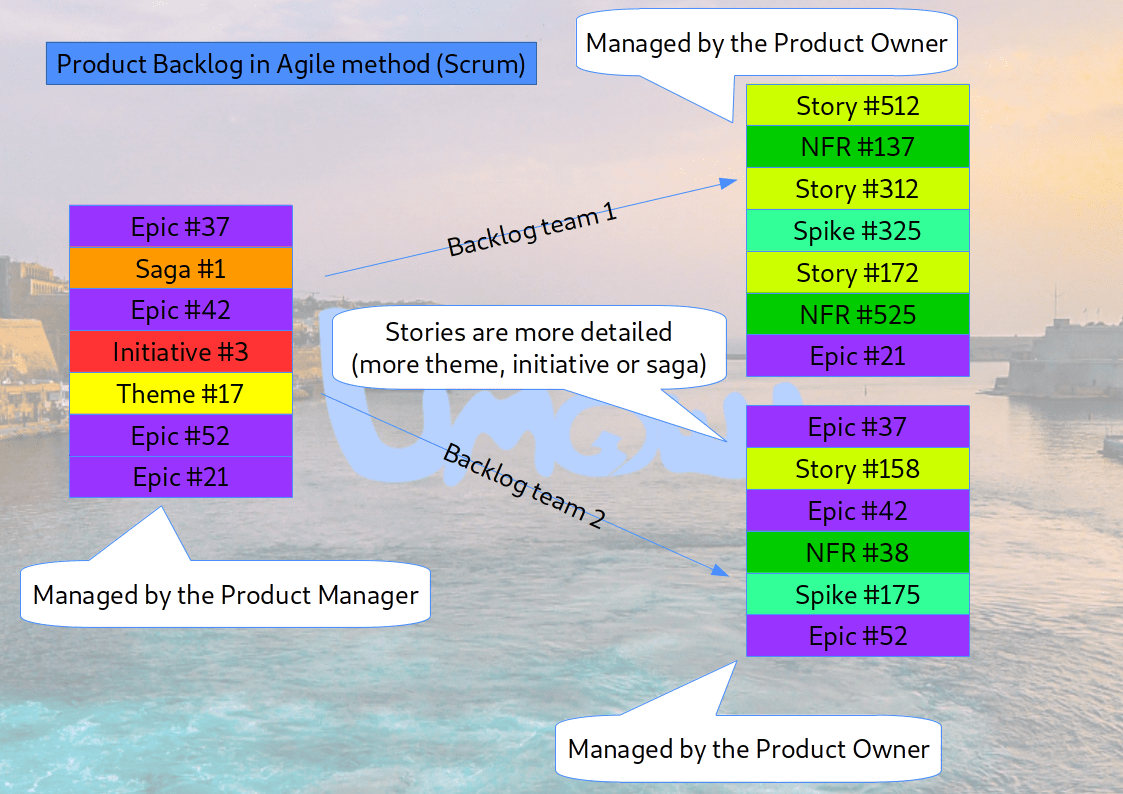
Product Backlog in Agile (Scrum)
This list is usually digital but can also be displayed on post-itsAll stories in the Sprint Backlog must be estimated by the team using Agile Poker.
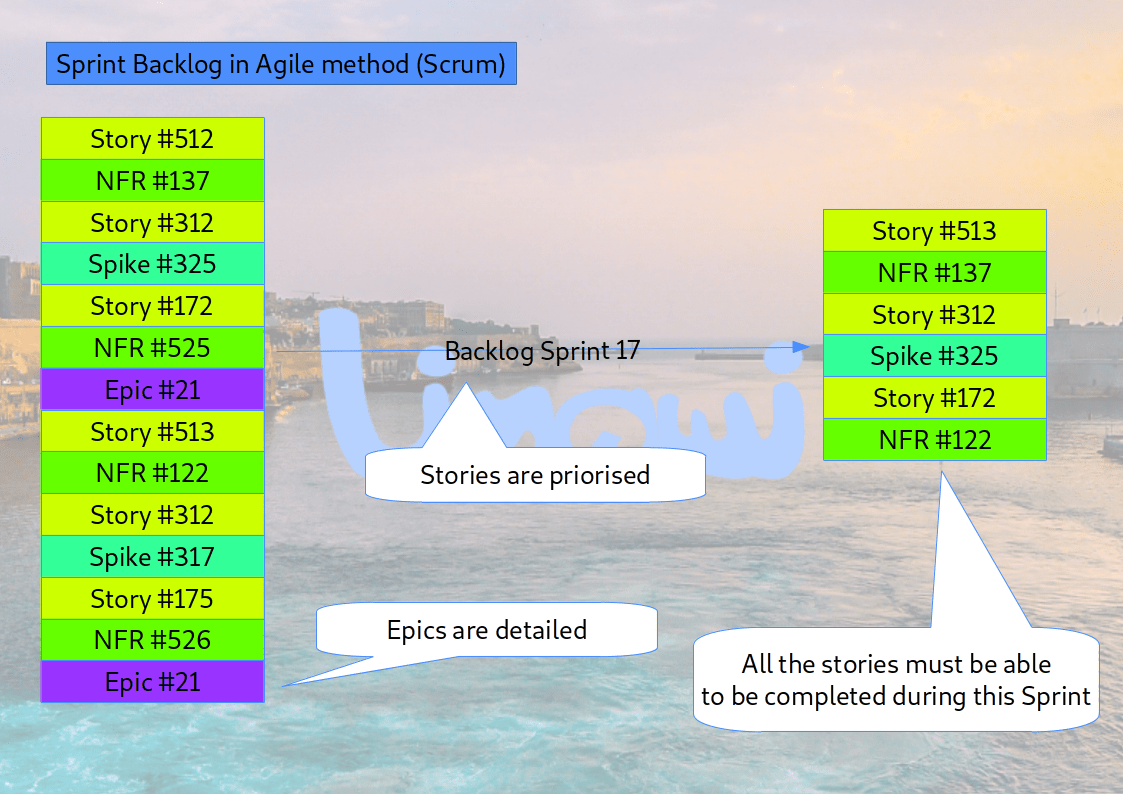
Sprint Backlog in Agile (Scrum)
All stories in the Sprint Backlog must be estimated by the team using Agile PokerThe scope label can be defined by any project stakeholder following the project management strategy (team members or only the Scrum Master, for example). It also defines a sub-Backlog and allows multiple teams to work in parallel or directs stories to the team members best suited to handle them.
Examples of Labels
Progress labels I use:
- DISCUSSION: This story has not been analyzed yet. It’s a new input, a new idea…
- TODO: This story has been estimated and extracted from the Backlog by the Product Owner for the current Sprint Backlog. It has not yet been started by the team.
- DOING: After TODO, once the team has started working on the story.
- REVIEW: After DOING, once the team believes the story is completed. A team member who did not participate in this story or an external reviewer evaluates whether the work matches the story. There is often a back-and-forth between DOING and REVIEW to refine the match between the story and its implementation.
- DONE: After REVIEW, once the reviewer has given the green light. The story is completed. The definition of DONE is important and may vary depending on the type of story and the initial definition given during Sprint 0 or Discovery & Framing. Typically, the Product Owner moves the story to DONE.
- POSTPONED: This story was misestimated or a problem occurred during the Sprint. It is postponed to a following Sprint.
Scope labels:
- SECURITY: This story involves security aspects. It is handled by specialized security members.
- PERFORMANCE: This story involves performance aspects. It is handled by specialized performance members.
- DOC: This story involves documentation. It is handled by specialized documentation members.
- TEST: This story involves testing. It is handled by specialized testing members.
Scrum Board
The stories from the Sprint Backlog can be displayed on a Scrum Board.
It is a column-based board, with each column representing a progress label. The columns are arranged left to right according to the logical order of progress labels.
The idea is to move stories from left (TODO) to right (DONE). An effective Agile team has all stories in DONE by the end of the Sprint.
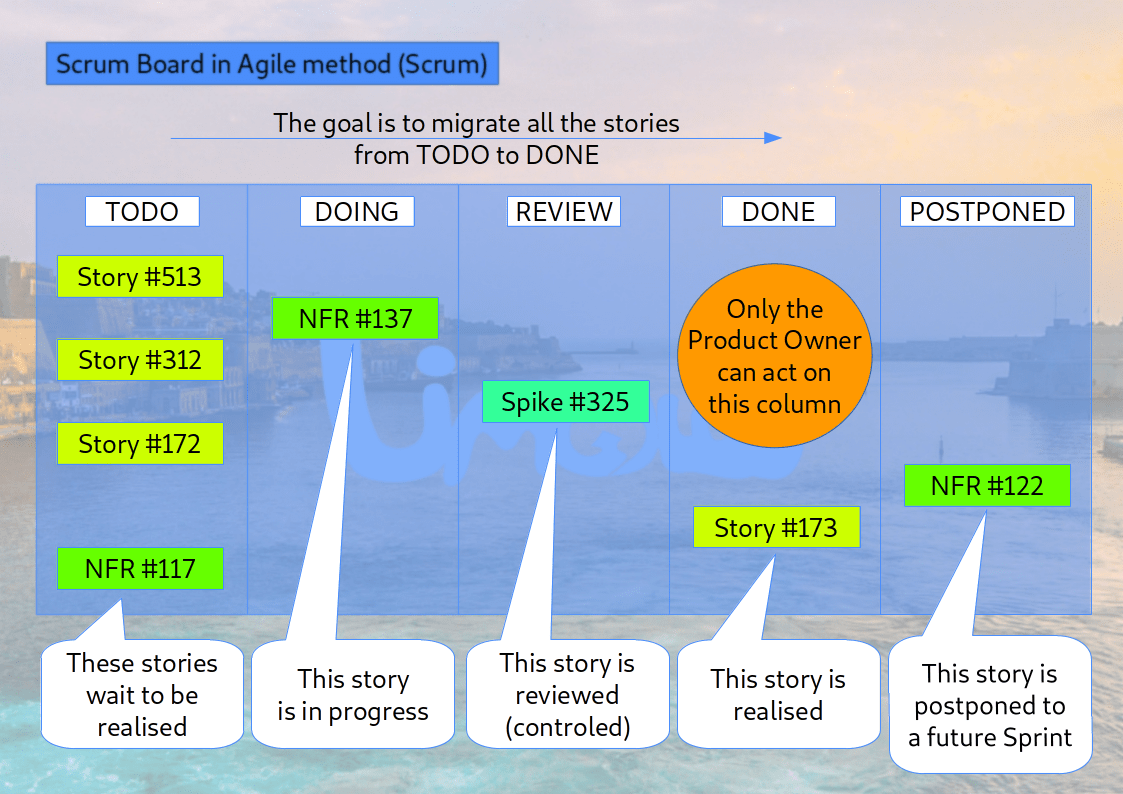
Scrum Board in Agile (Scrum)
Columns are arranged left to right according to the logical order of progress labels