Agile poker
Agile poker is a playful way to assess the complexity of Stories in agile methodology.
Agile Method: General Overview
Agile Poker is presented in the form of a set of cards, with each person receiving a complete deck. During the Sprint ceremony, the team uses the cards to evaluate the complexity of the stories ( User Stories, NFR, or Spike) being considered.
Note: This post was translated from french with the help of AI. The original post was written with the knowledge of a younger me.
Complexity Point
To estimate the difficulty of completing a story, the first instinct might be to determine a duration.
This approach can create a stressful environment. Indeed, a developer (or marketer, etc.) responsible for the story might feel pressured by time and complete the story too quickly and poorly.
Of course, the review phase can address this issue by repeating parts of the story over and over, but this is a waste of time, energy, and resources.
This is where the complexity point comes in.
This tool allows assigning a complexity value to the story. The value can be relative to other stories or absolute.
In software development, the agile complexity point can mirror the complexity of the code to be written. For example:
- one class = 1 point, 3 classes = 3 points
- 1 point per method
- based on calculated complexity (e.g., in PHP)
Each story is assigned complexity points via Agile Poker.
Velocity
The complexity point is not initially tied to duration.
Once an agile team becomes well-practiced (i.e., after several Sprints), it is possible to determine the average number of complexity points the team can complete per Sprint.
This is velocity.
It is a batch approach, but trying to over-detail the average time per complexity point can create stress again.
Once an average velocity is estimated, the goal is to measure the team’s performance and maintain that velocity.
It is not always wise to try to increase it, to avoid reverting to a stressful situation.
Poker Rules
For each story, every team member selects a card from their deck and keeps it hidden. The card represents their estimation of the [story]’s complexity.
Once everyone has chosen, all cards are revealed simultaneously.
Those whose cards are farthest from the average explain their reasoning. A consensus is then reached on the team’s estimated complexity.
The available decks below are 7 in number (for a standard agile team) and are distinguishable by color.
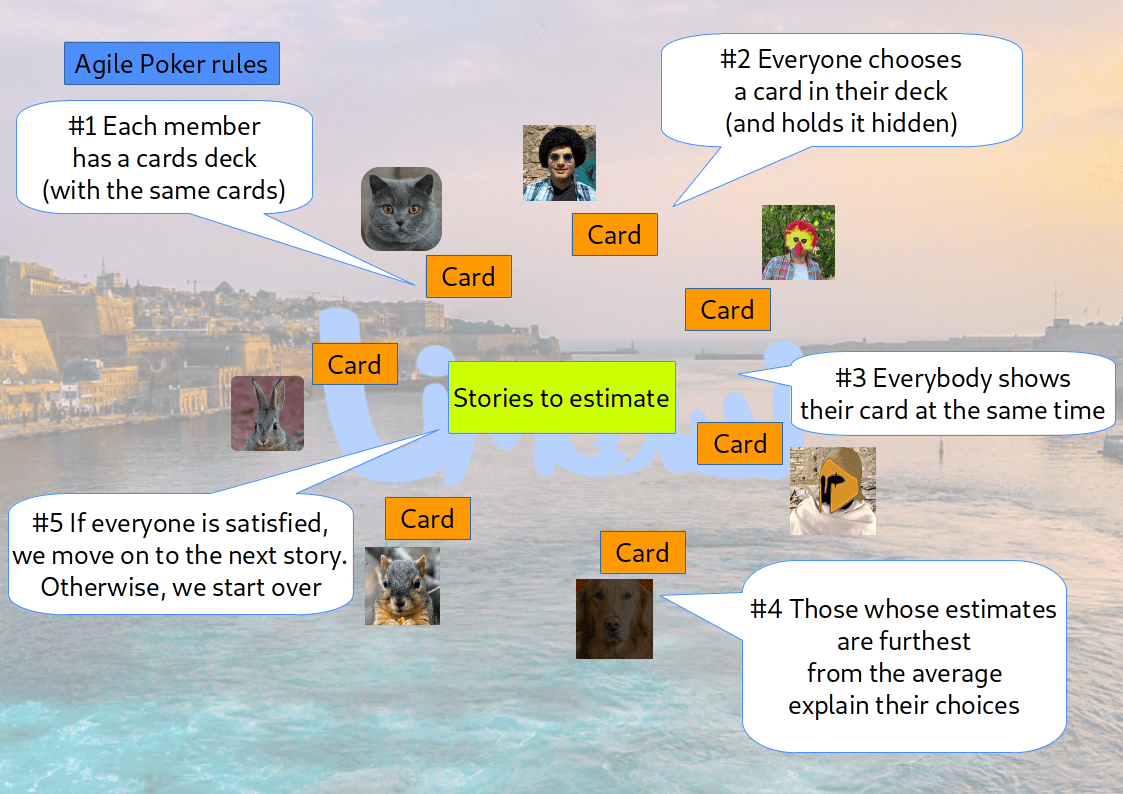
Agile Poker Rules
This card represents their estimation of the story’s complexityEach deck contains:
- a Fibonacci sequence: for precise estimates or workdays (for Spikes) using the grid in the center (one column represents a full week);
- T-shirt sizes: for less precise estimates;
- a plus and minus: to approve or disapprove;
- a question mark: when unsure;
- a coffee: when it’s time for a break;
- infinity: when the story is too large and needs to be broken down.
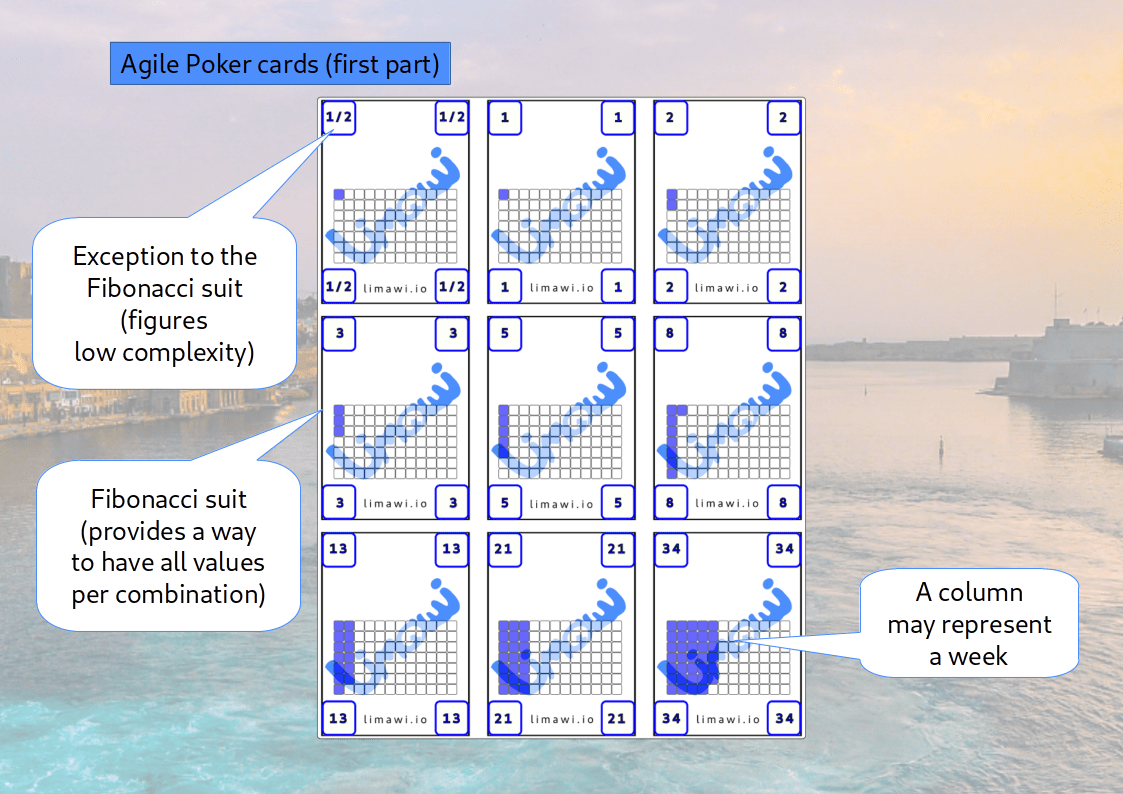
Agile Poker Board 1
First Agile Poker card board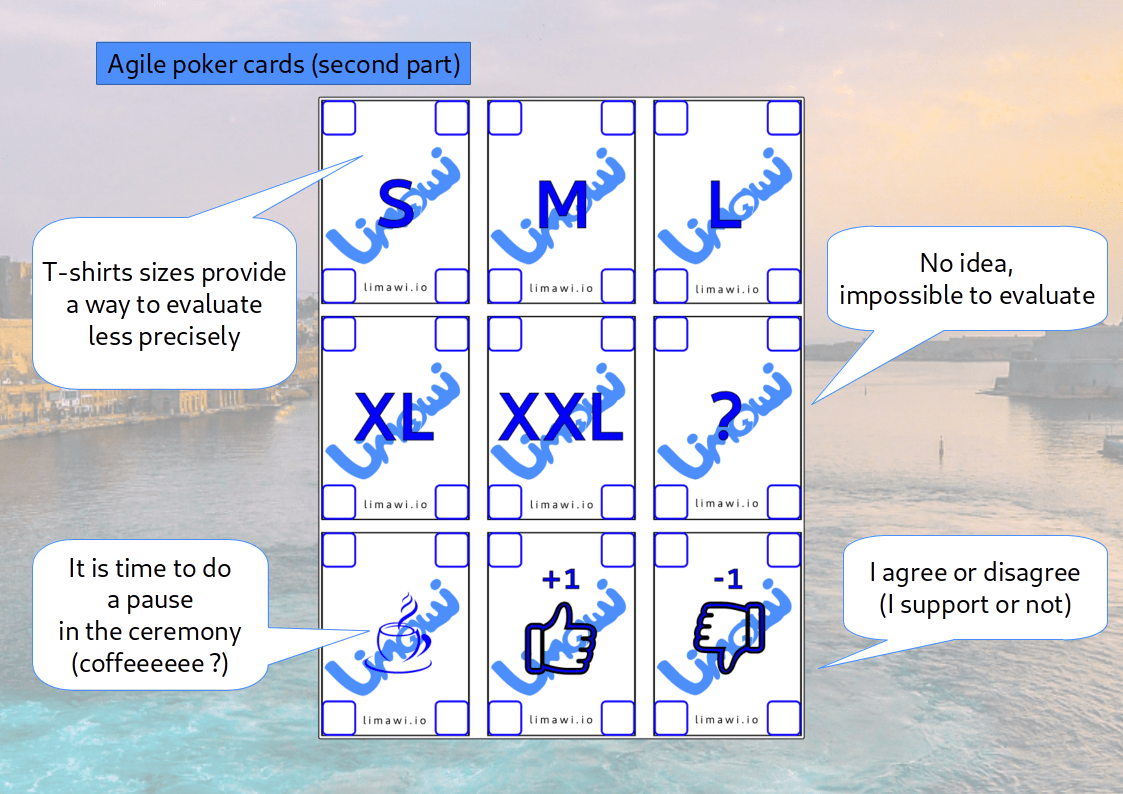
Agile Poker Board 2
Second Agile Poker card board